Mixed-Species Flocks
4-channel Soundscape Installation
10:00 mins


Mixed-Species Flocks emerges from the experience of a year spent in the Curatorial Studies (CS) program. It draws a parallel between two forms of temporary communities composed of people from diverse backgrounds, brought together through collaborative learning and shared work towards a common goal, while remaining shaped by each participant's individual aspirations.

The birds' songs echo the different voices that made up the Curatorial Studies cohort. Each participant was invited to select a bird species native to their region of origin to become part of a shared soundscape. The intention was to bring together voices from different latitudes that carried an emotional, or simply personal, significance for each participant. In this way, the soundscape is composed of both a perceptible dimension, the birdsong itself, and another that remains imperceptible to the listener: the intimate heritage each participant brings to it.
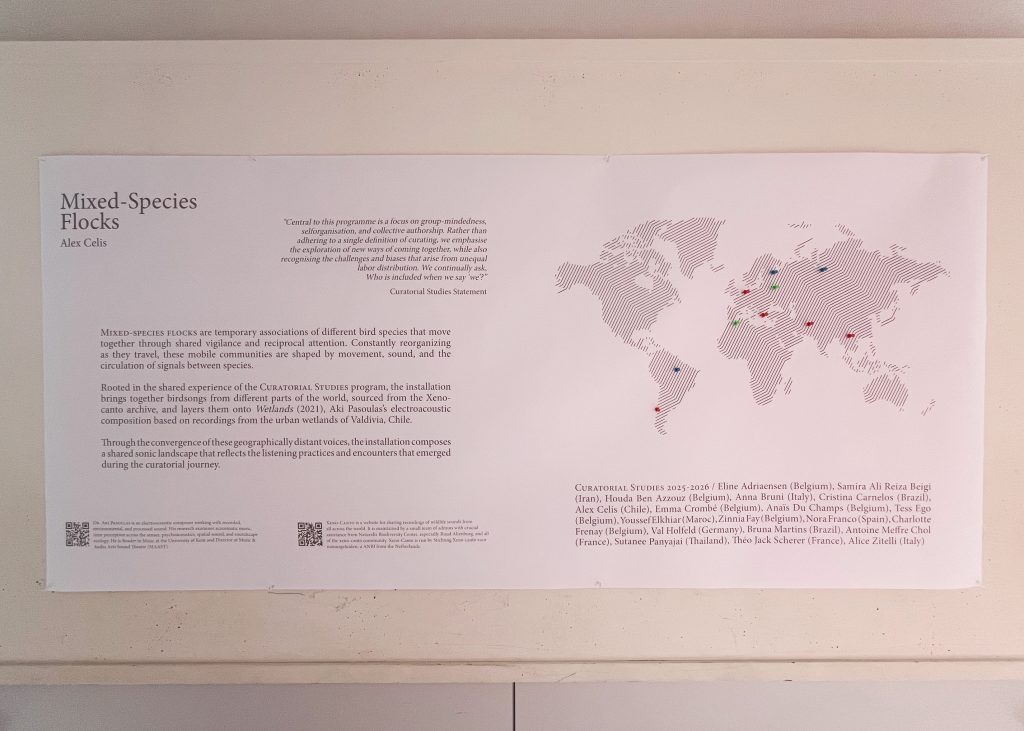
One of the most compelling aspects of working with birds is that, when speaking of their origins, distinctions between countries, and often even between regions, quickly become irrelevant. This is evident in migratory species, but equally true of birds such as pigeons, whose presence extends across cities throughout the world. Like plants and humans, birds move for many different reasons, whether natural, voluntary or forced. From their perspective, borders are permeable and diffuse, ultimately devoid of meaning. For this reason, the map used to locate the participants' places of origin could not be a political one, but rather an abstraction stripped of borders and detailed references.

The decision to use birdsong to evoke the experience of Curatorial Studies, as well as the title of the project itself, borrowed from a natural phenomenon, does not seek to idealize the experience of community as harmonious or without conflict. The work is not intended to portray collaboration as a spontaneous form of togetherness, nor as a practice free of tensions. Instead, it presents a sonic experience of shifting textures, rhythms and intensities, in which the landscape is continually shaped by the very voices that inhabit and traverse it.
This circular relationship between the landscape and the elements that constitute it lies at the core of the soundscape as an artistic form. Independently recorded and produced sounds are brought together to create the very environment in which they unfold. This apparent paradox, suggested by the idea of circular causality, offers a way of thinking not only about collaborative forms of working but also about the simultaneously central and relative role of the individual, as represented by their intermittent appearance within the sonic landscape.

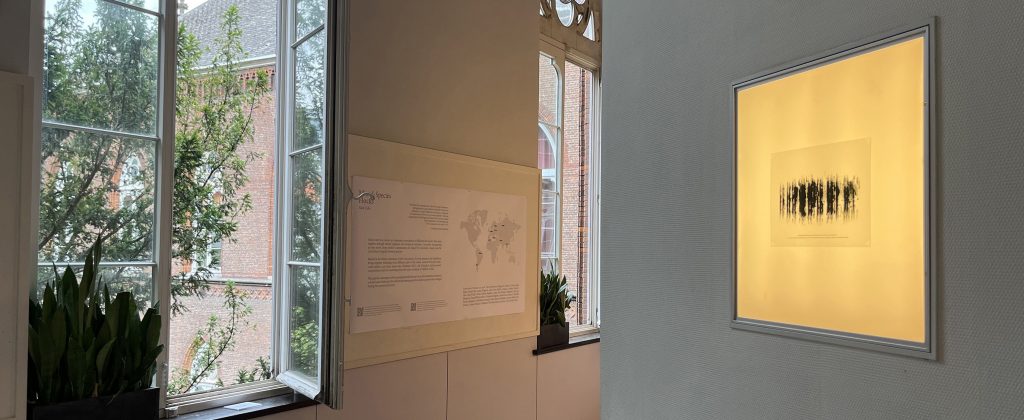
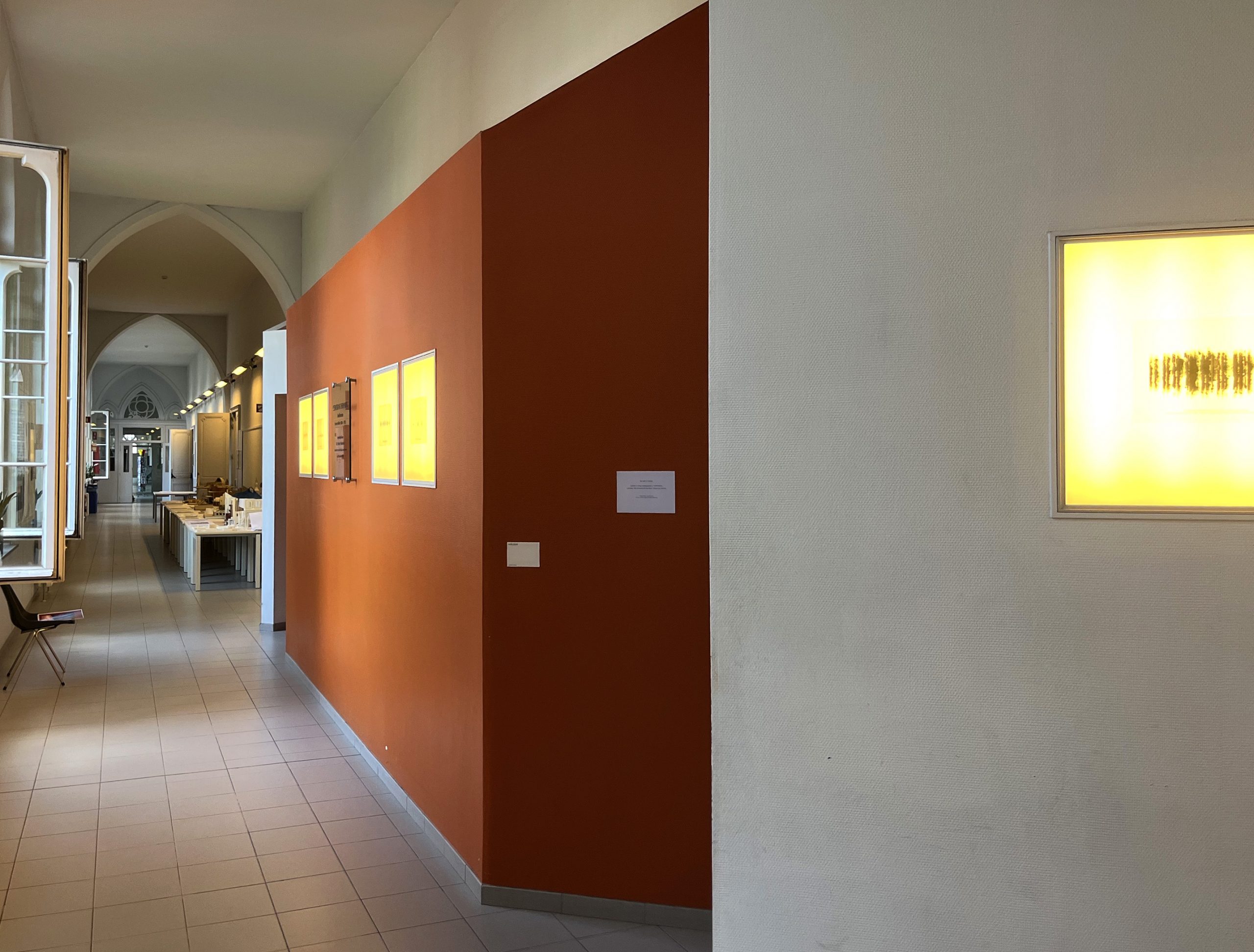
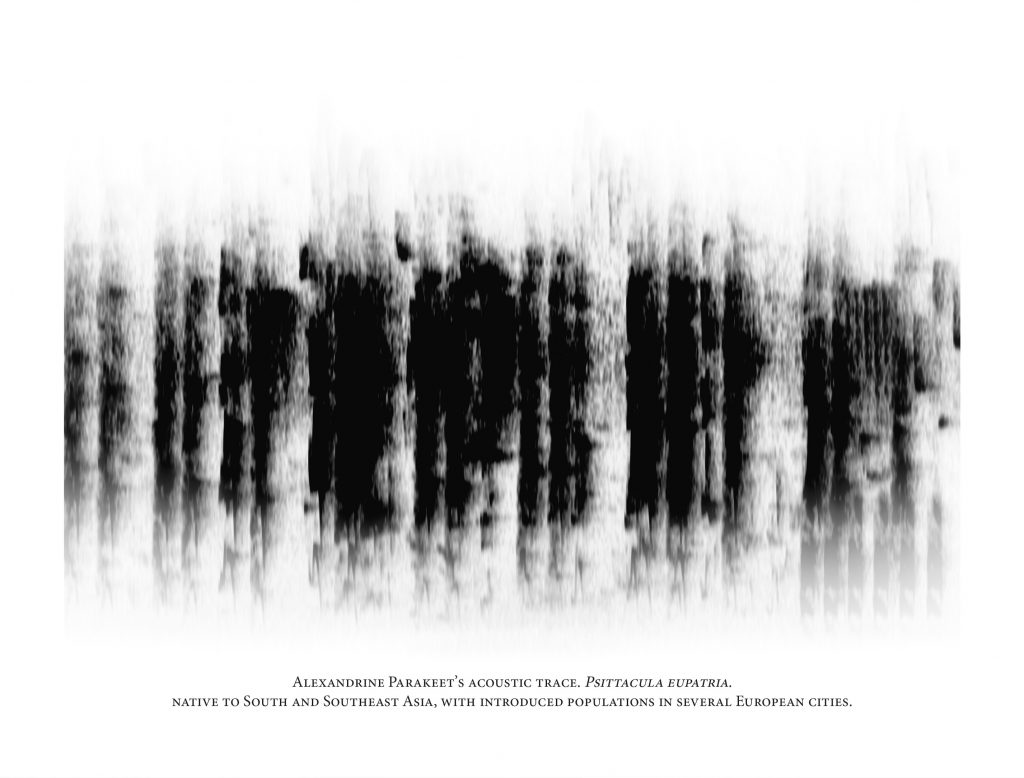
To foreground the singularity of each bird's song, the installation also included the reproduction of the acoustic traces of several species. These traces, graphic renderings of each bird's sound, were developed to form a personal horizon, a landscape towards which each one is projected. A landscape that remains deliberately unfinished, not because of uncertainty or fragile convictions, but because it is inevitably transformed by the interference of other voices.
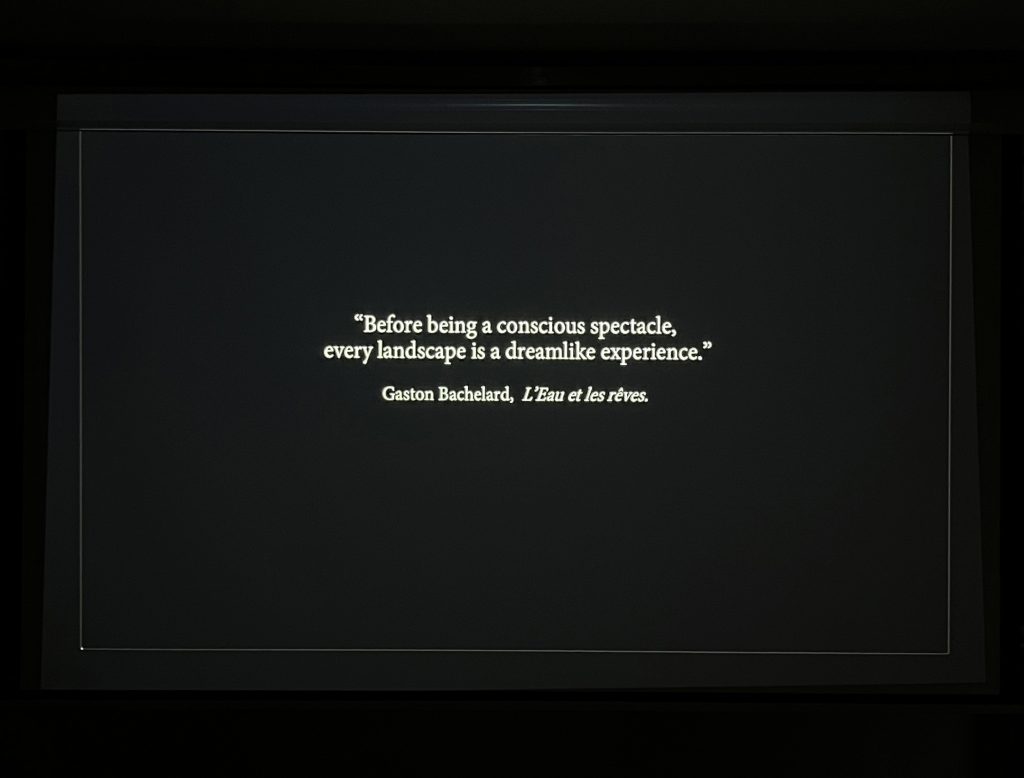
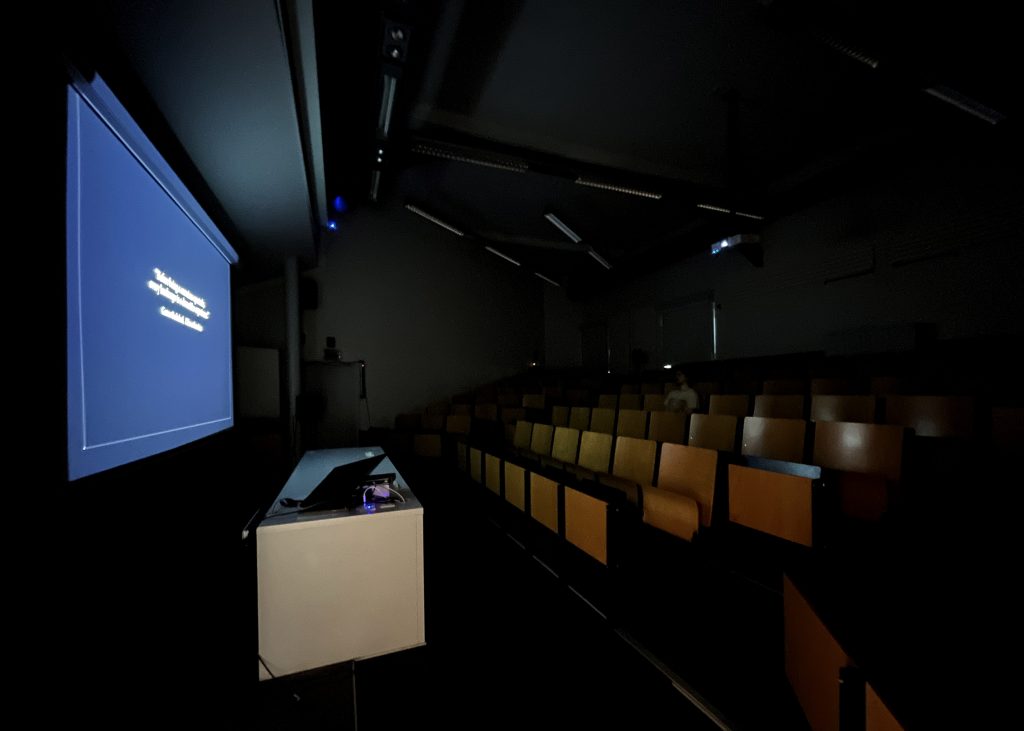
It is here that the quotation by Gaston Bachelard, projected during the playback of the soundscape, finds its place:


       "Before being a conscious spectacle, every landscape is a dreamlike experience."


The quotation brings together two ways of approaching landscape: one defined by the geographical and material characteristics of the places we inhabit, the other by what might be called each person's intimate heritage. In other words, landscape, understood as a dreamlike experience, emerges from the encounter between a sensibility shaped by memories, longings, fears, and apprehensions, and the constellation of elements that makes up what we call nature. In this sense, the quotation extends beyond the specific experience of Curatorial Studies, inviting visitors to reflect on the landscapes they themselves inhabit, remember and imagine.
The soundscape incorporates Aki Pasoulas's electroacoustic composition Wetlands, created in 2021 in the wetlands surrounding the city of Valdivia, in southern Chile. The work introduces a sonic landscape that dislocates the installation site itself, KASK, in Ghent. In doing so, the landscape of Curatorial Studies enters into dialogue with distant, unfamiliar, and unexpected elements, brought into a learning environment situated only a few kilometers from one of Europe's historic capitals.

Mixed-Species Flocks is a sound piece that evokes the experience of a year of interdisciplinary and intercultural learning. A gesture that moves away from the dominance of vision, offering a moment of rest to our weary gaze. A landscape rich in birdsong and echoes, emerging from the very relationships that took shape there. A journey that continues, extending today towards different horizons.
Curatorial Studies 2025-2026 are: Eline Adriaensen (Belgium), Samira Ali Reiza Beigi (Iran), Houda Ben Azzouz (Belgium), Anna Bruni (Italy), Cristina Carnelos (Brazil), Alex Celis (Chile), Emma Crombé (Belgium), Anais Du Champs (Belgium), Tess Ego (Belgium), Youssef Elkhiar (Maroc), Zinnia Fay (Belgium), Nora Franco (Spain), Charlotte Frenay (Belgium), Val Holfeld (Germany), Bruna Martins (Brazil), Antoine Meffre Chol (France), Sutanee Panyajai (Thailand), Théo Jack Scherer (France), Alice Zitelli (Italy)
Acknowledgements
Many people contributed to the development of this project. My sincere thanks go to Laurens Mariën, Sara Plantefève-Castryck, Eline Harmse and Siegrid Demyttenaere (Graduation Show 2026, KASK), Ingrid Leonard (FOMU), the Curatorial Studies 2025-2026 students, Laura Herman and Isabel Van Bos (Curatorial Studies, KASK), Dr. Aki Pasoulas, the Xeno-Canto archive, and Marcelo Romero.